Welcome!

Welcome to our virtual booth. On this page you will be able to view our booth, examine the details of our posters, download Basic Editions of our Cranium and Synapse software programs, collect brochures, and more.

Play the video to the right to get an overview of our booth.
In the image below click or tap on an item of interest. The webpage will scroll down to the section describing that item in more detail.

As always, please contact us if you need any additional information or have any questions about physical properties or chemical product design.

Click or tap on an item in our exhibit
booth to get more details:

ACHEMA 2024 - Frankfurt, Germany (back to booth)
If you will attend ACHEMA 2024, please visit our exhibit. We will be in Hall 9.0, Stand F24. We can demonstrate our Synapse and Cranium software products and discuss our consulting services. Some highlights include:
  • New machine learning capabilities which make it easy to use your own data to extend and even develop new estimation techniques.
  • Regression-based estimation techniques that dynamically interpolate and extrapolate experimental data to new temperatures, pressures, and compositions.
  • New services to help you use our software products to distribute physical property data and estimates throughout your organization.
You can use our Voucher Code, A_gXH5reE3 (), to obtain your free one-day visitor pass at ACHEMA's visitor registration page .
Wall Posters
Synapse: Design Chemical Products (back to booth)
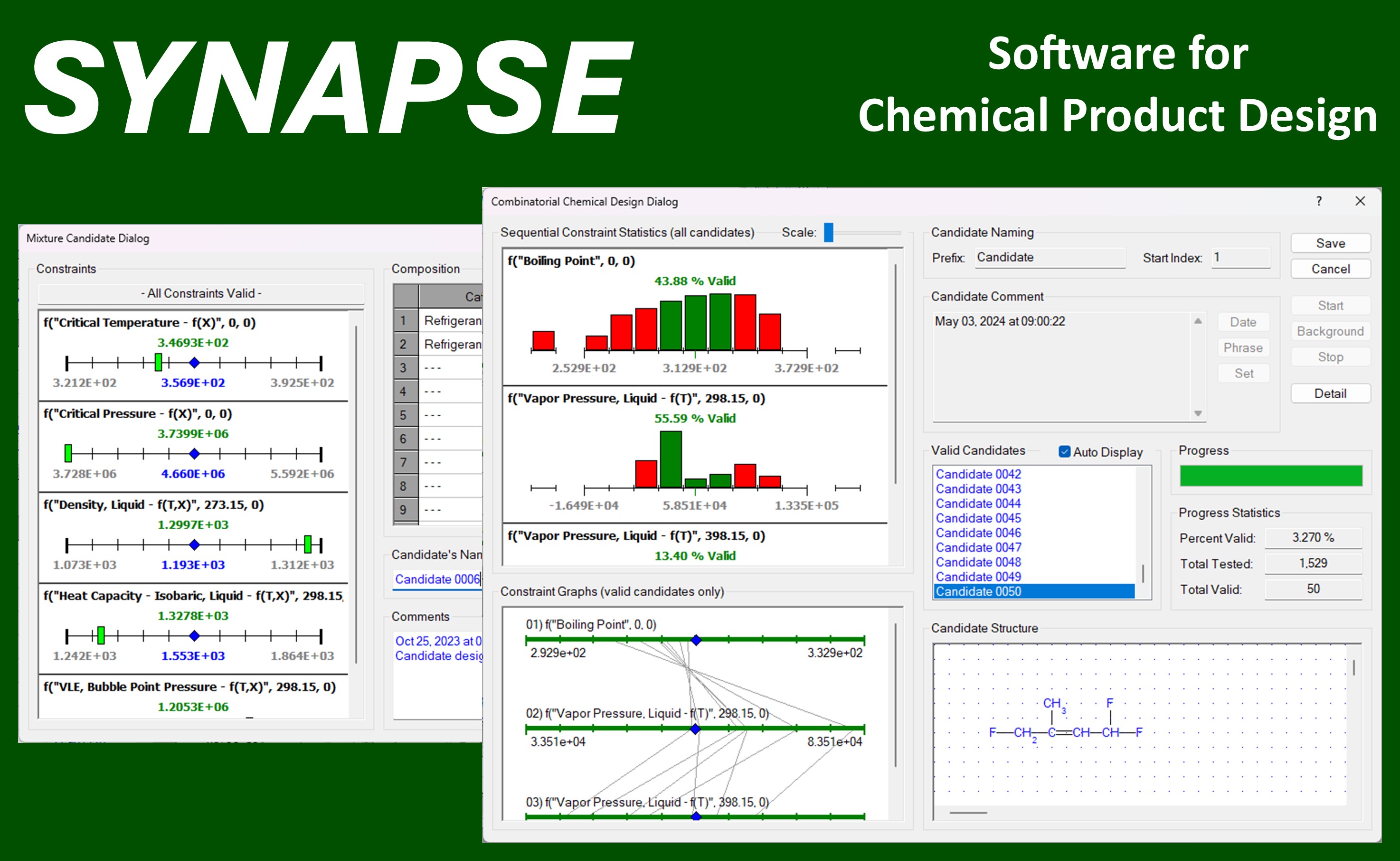
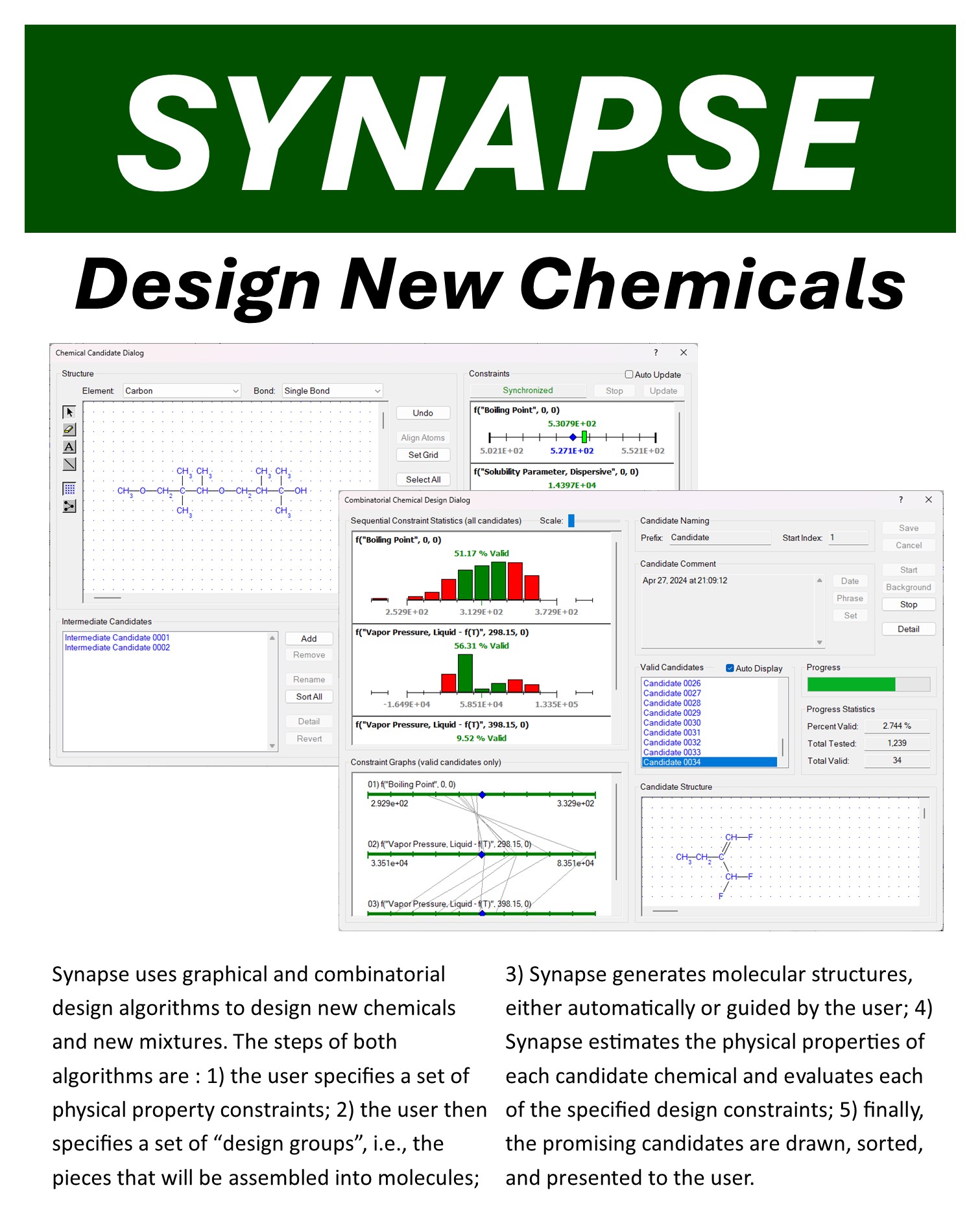
Synapse uses graphical and combinatorial design algorithms to design new chemicals and new mixtures. The steps of both algorithms are: 1) the user specifies a set of physical property constraints; 2) the user then specifies a set of “design groups”, i.e., the pieces that will be assembled into molecules; 3) Synapse generates molecular structures, either automatically or guided by the user; 4) Synapse estimates the physical properties of each candidate chemical and evaluates each of the specified design constraints; 5) finally, the promising candidates are drawn, sorted, and presented to the user.

For more information, please visit our Synapse documentation webpage.
Synapse: Select Solvents (back to booth)
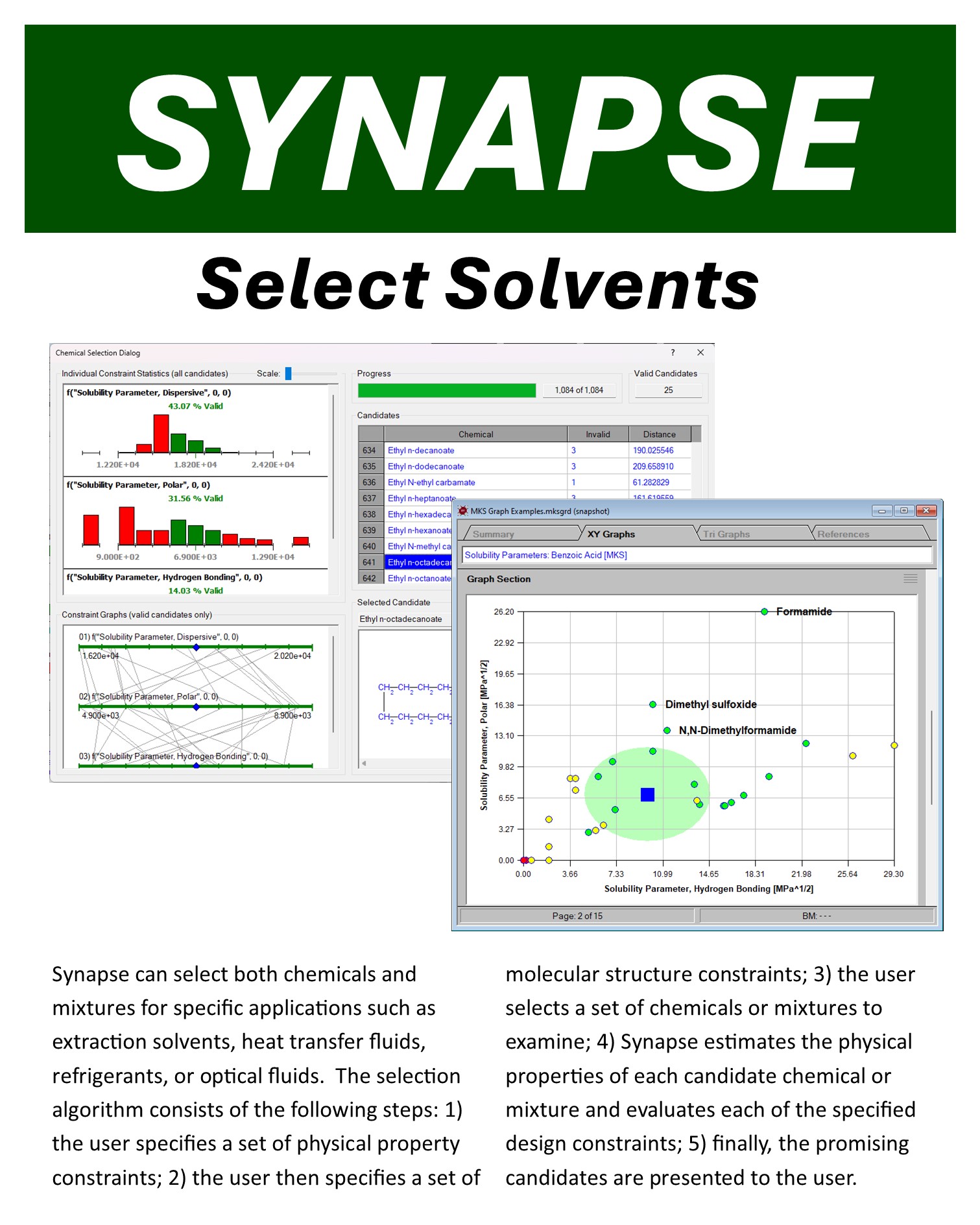
Synapse can select both chemicals and mixtures for specific applications such as extraction solvents, heat transfer fluids, refrigerants, or optical fluids. The selection algorithm consists of the following steps: 1) the user specifies a set of physical property constraints; 2) the user then specifies a set of molecular structure constraints; 3) the user selects a set of chemicals or mixtures to examine; 4) Synapse estimates the physical properties of each candidate chemical or mixture and evaluates each of the specified design constraints; 5) finally, the promising candidates are presented to the user.
Synapse: Machine Learning (back to booth)
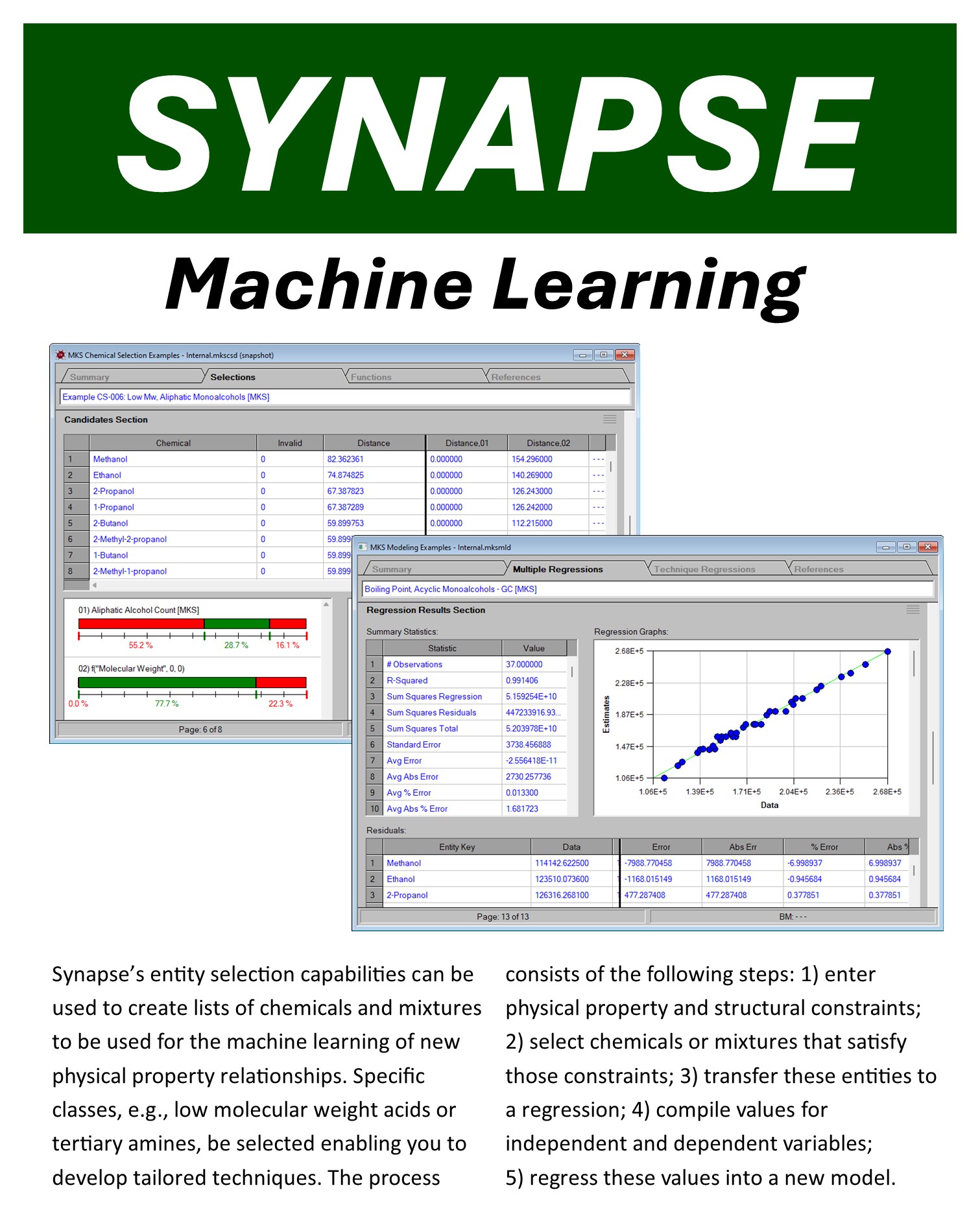
Synapse’s entity selection capabilities can be used to create lists of chemicals and mixtures to be used for the machine learning of new physical property relationships. Specific classes, e.g., low molecular weight acids or tertiary amines, be selected enabling you to develop tailored techniques. The process consists of the following steps: 1) enter physical property and structural constraints; 2) select chemicals or mixtures that satisfy those constraints; 3) transfer these entities to a regression; 4) compile values for independent and dependent variables; 5) regress these values into a new model.
Cranium: Physical Properties (back to booth)
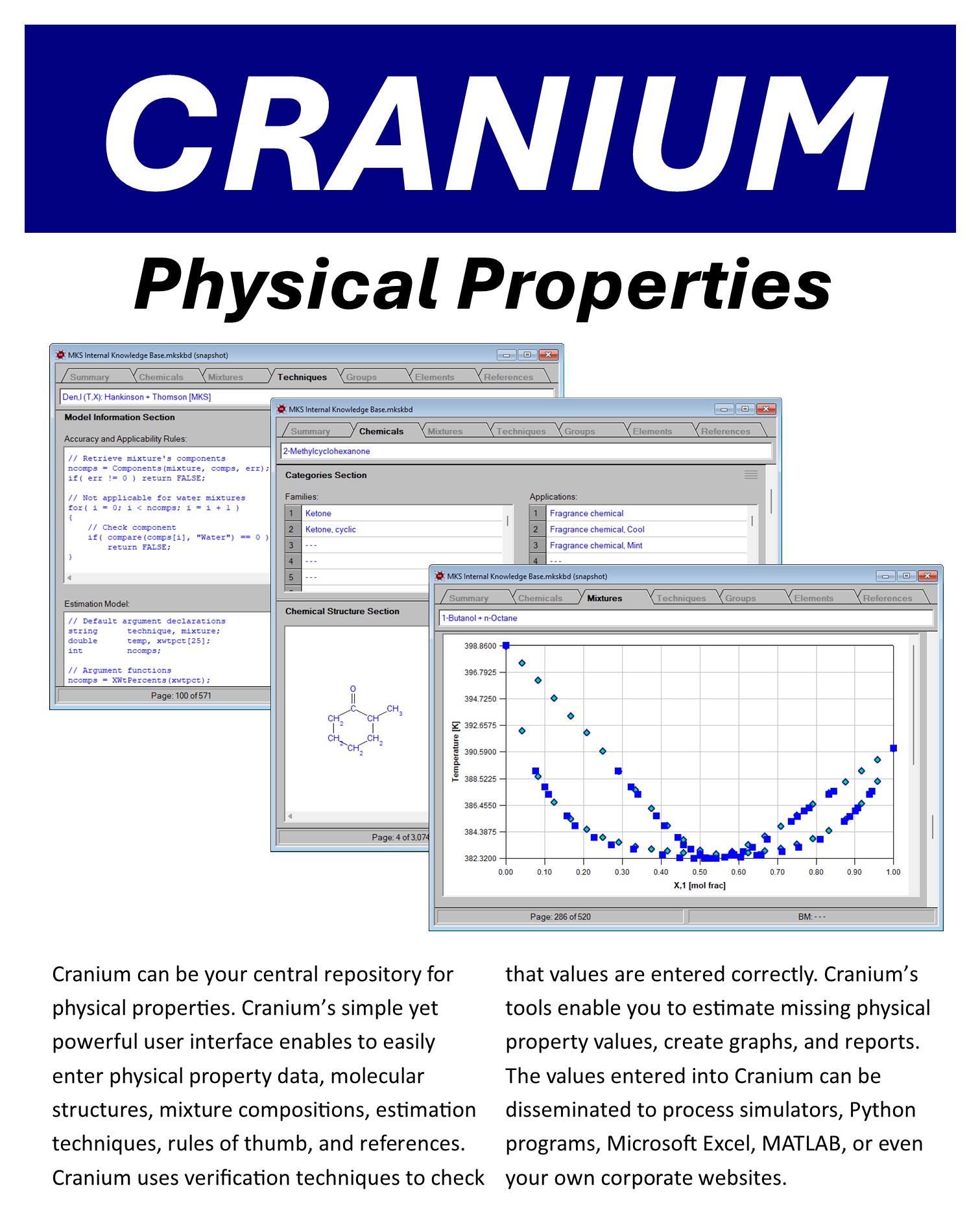
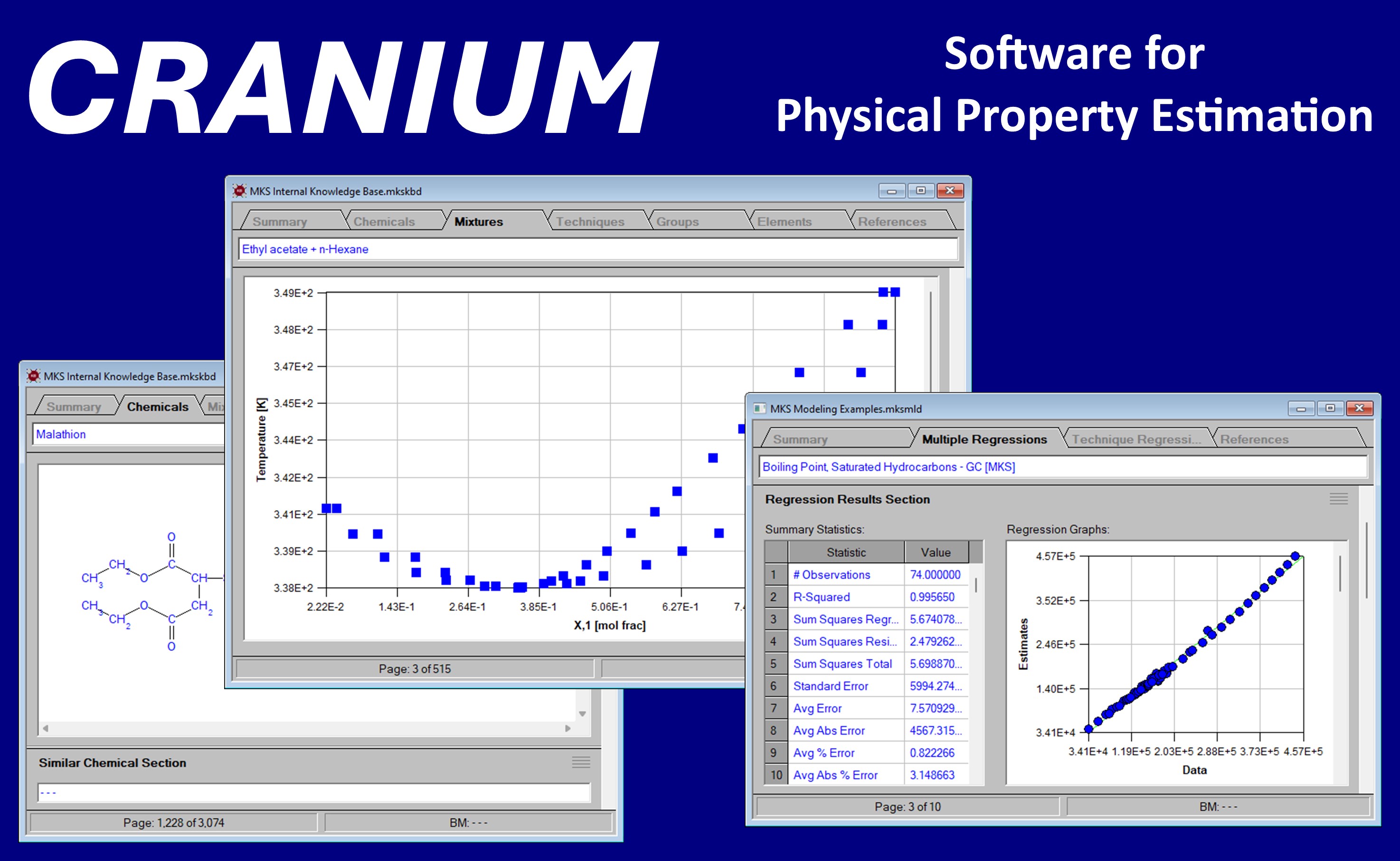
Cranium can be your central repository for physical properties. Cranium’s simple yet powerful user interface enables to easily enter physical property data, molecular structures, mixture compositions, estimation techniques, rules of thumb, and references. Cranium uses verification techniques to check that values are entered correctly. Cranium’s tools enable you to estimate missing physical property values, create graphs, and reports. The values entered into Cranium can be disseminated to process simulators, Python programs, Microsoft Excel, MATLAB, or even your own corporate websites.
Cranium: Estimate Properties (back to booth)
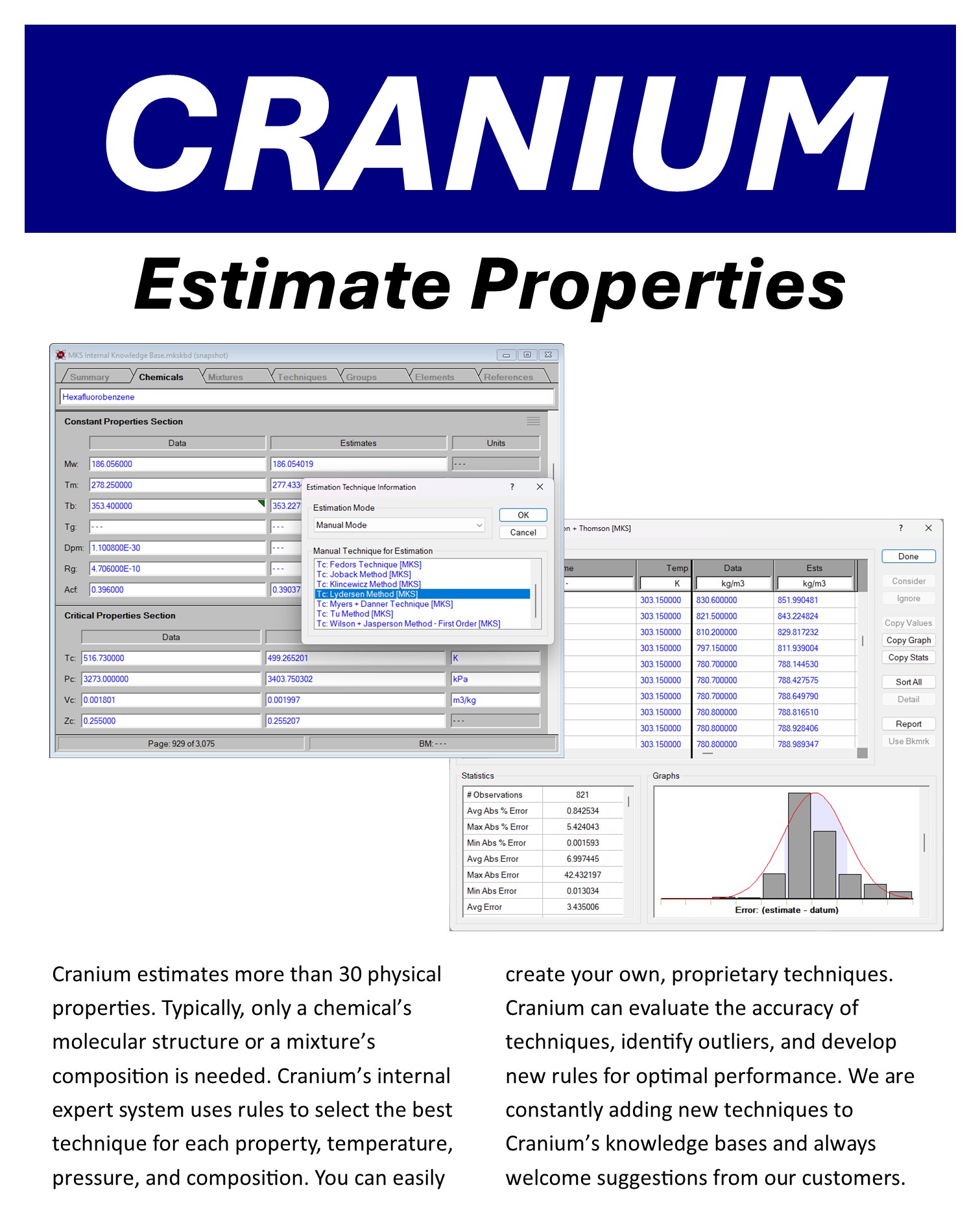
Cranium estimates more than 30 physical properties. Typically, only a chemical’s molecular structure or a mixture’s composition is needed. Cranium’s internal expert system uses rules to select the best technique for each property, temperature, pressure, and composition. You can easily create your own, proprietary techniques. Cranium can evaluate the accuracy of techniques, identify outliers, and develop new rules for optimal performance. We are constantly adding new techniques to Cranium’s knowledge bases and always welcome suggestions from our customers.
Cranium: Machine Learning (back to booth)
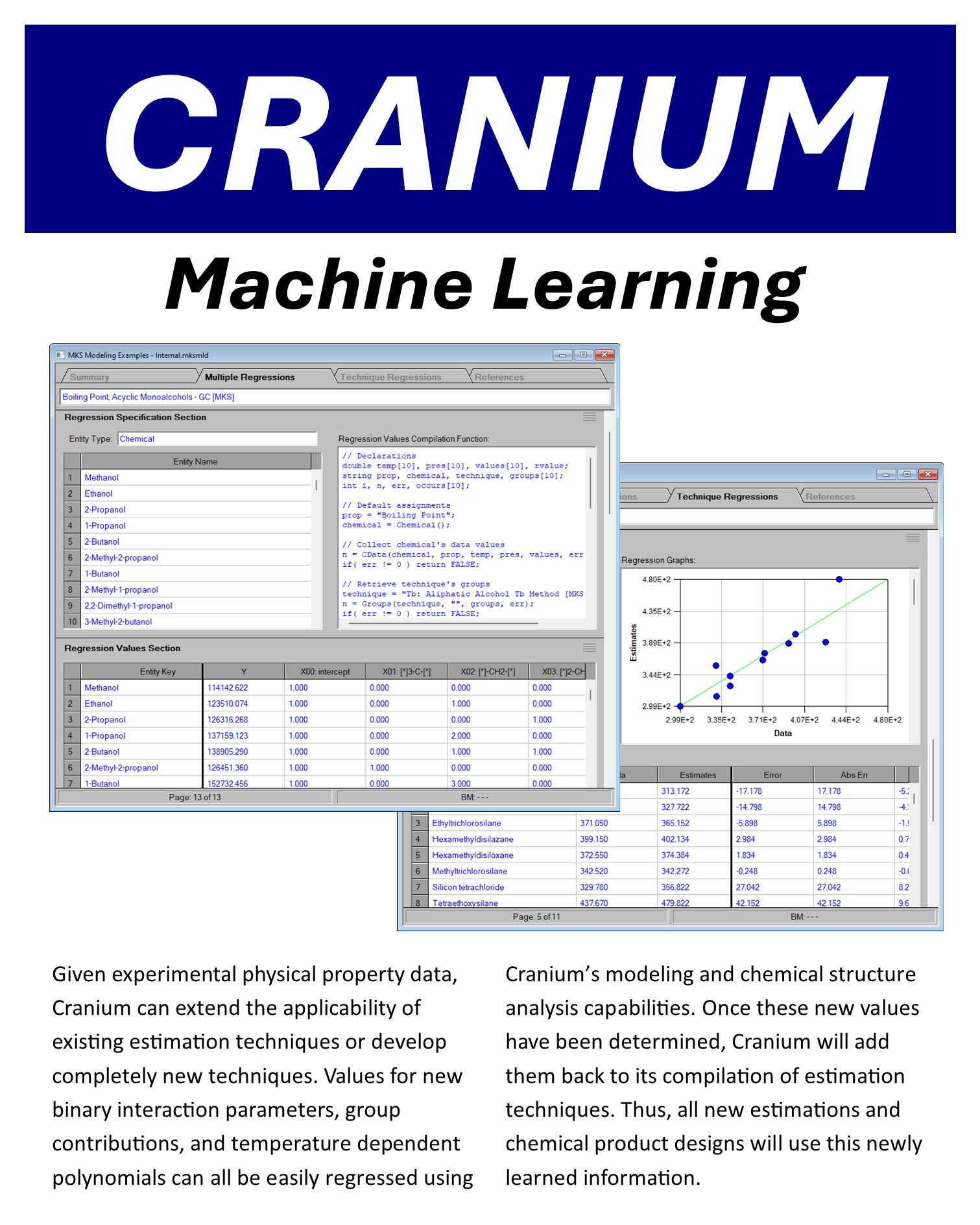
Given experimental physical property data, Cranium can extend the applicability of existing estimation techniques or develop completely new techniques. Values for new binary interaction parameters, group contributions, and temperature dependent polynomials can all be easily regressed using Cranium’s modeling and chemical structure analysis capabilities. Once these new values have been determined, Cranium will add them back to its compilation of estimation techniques. Thus, all new estimations and chemical product designs will use this newly learned information.
MKS Computer Programs
Synapse: Software for Chemical Product Design (back to booth)
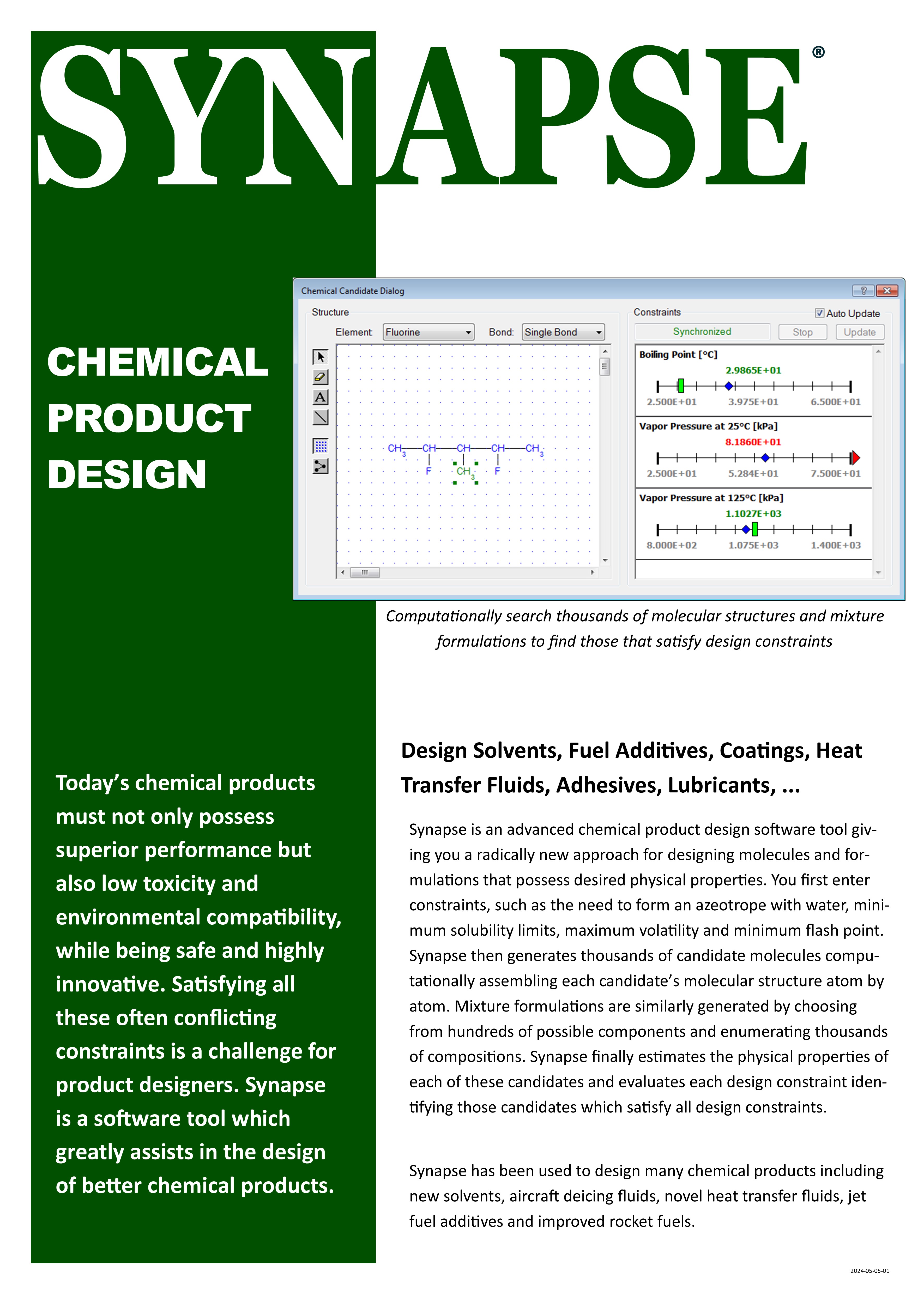
Synapse is an advanced chemical product design software tool giving you a new approach for designing molecules and formulations that possess desired physical properties. You first enter constraints, such as the need to form an azeotrope with water, minimum solubility limits, maximum volatility and minimum flash point. Synapse then generates thousands of candidate molecules computationally assembling each candidate’s molecular structure atom by atom. Mixture formulations are similarly generated by choosing from hundreds of possible components and enumerating thousands of compositions. Synapse finally estimates the physical properties of each of these candidates and evaluates each design constraint identifying those candidates which satisfy all design constraints. For more information, please visit Synapse's webpage at: Synapse Software or download the Basic Edition (an extensive demonstration of Synapse's capabilities) at: Synapse, BasicEdition. Also see details about our online demonstrations below.
Cranium: Software for Physical Property Estimation (back to booth)
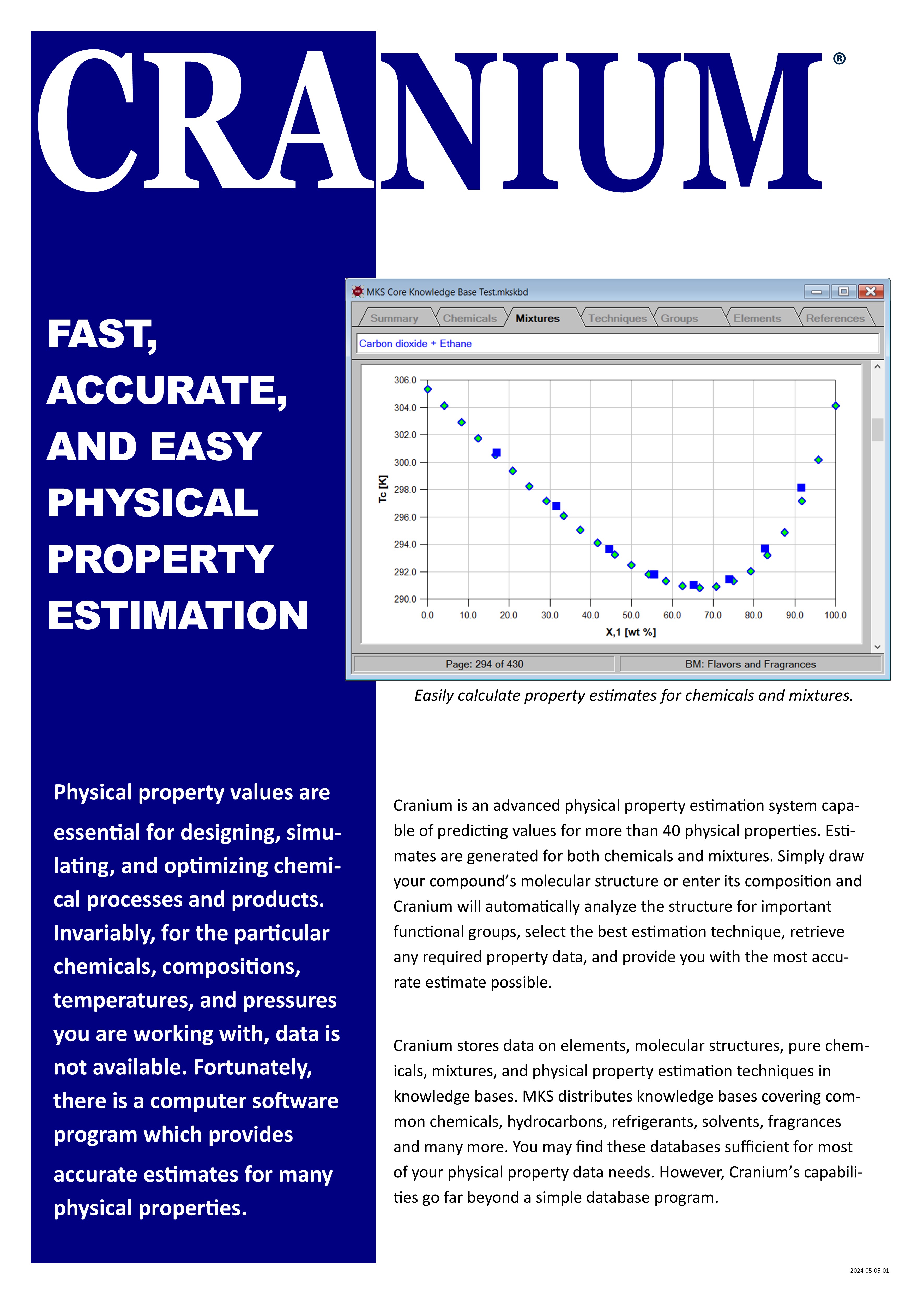
Cranium is an advanced physical property estimation software capable of predicting the values of more than 30 physical properties. To generate estimates, you simply need to draw your chemical's molecular structure or enter your mixture's composition. Cranium uses a set of rules to select the best estimation technique for your chemicals of interest. Cranium provides powerful capabilities for creating graphs, regressing technique parameters, creating new group contribution techniques, and managing your company's physical property knowledge. Cranium can export its physical property data and estimates to process simulators, spreadsheets, and other chemical software. For more information, please visit Cranium's webpage at: Cranium Software or download the Basic Edition (an extensive demonstration of Cranium's capabilities) at: Cranium, BasicEdition. Also see details about our online demonstrations below.
Online Capabilities of Cranium and Synapse (back to booth)
The WebServer Editions of both Synapse and Cranium enable you to distribute physical property data, estimates, and calculations over the internet to online applications and webpages. As a demonstration of the WebServer Editions' capabilities, we developed the following webpages:
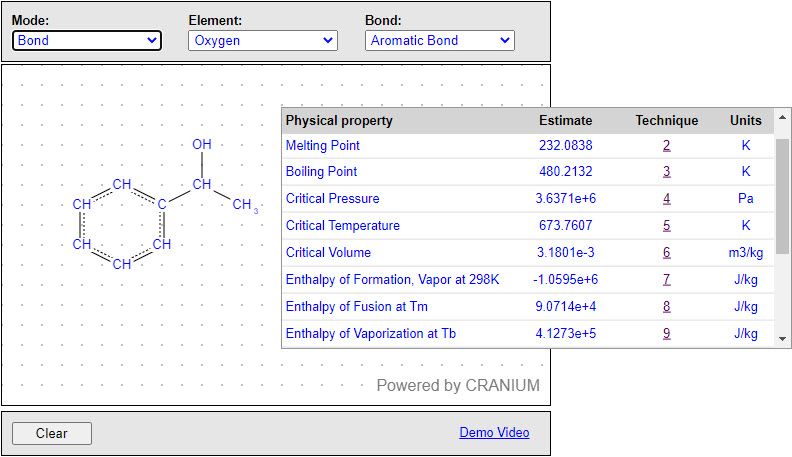
  • Online Physical Property Estimation: just draw your molecule's structure and Cranium's WebServer Edition (running in the cloud on an Azure virtual machine) will estimate more than 30 physical properties.
  • Online Physical Property Data and Estimates: a web application demonstrating how to use Cranium's WebServer Edition to distribute your company's physical property data and recommended estimates via a webpage.
  • Finding Azeotropes of Binary Mixtures: a web application demonstrating how to use Cranium's WebServer Edition to estimate the physical properties needed to predict the occurrence of an azeotrope in a binary mixture.
Podium Posters
Chemical Product Design (back to booth)

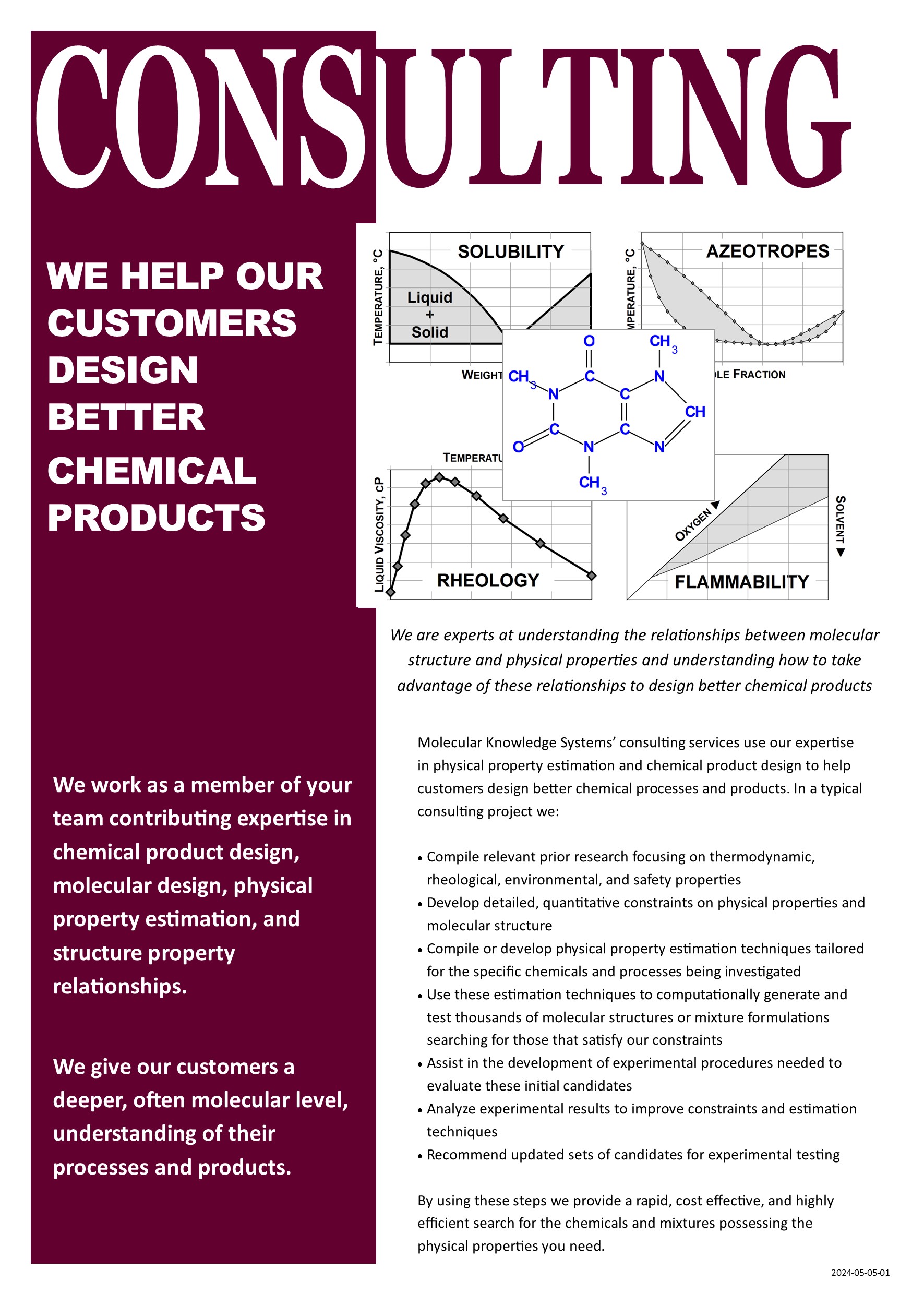
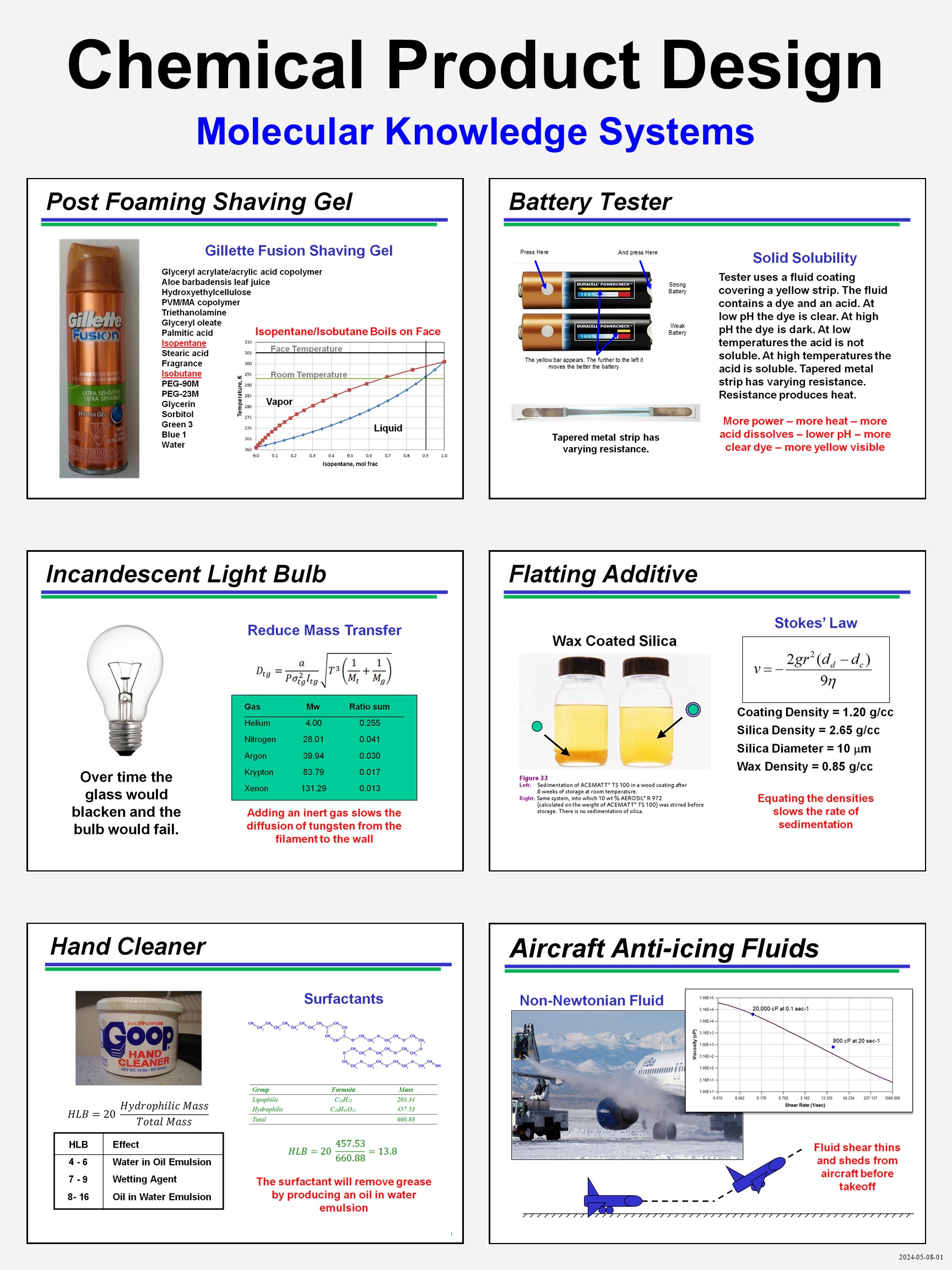
The behavior of chemical products is a function of their physical properties. And, the values of physical properties is a function of their molecular structure and composition. Thus, understanding how to manipulate physical properties is key to designing chemical products.

This poster demonstrates how physical properties affect the performance of a wide range of common chemical products:

Post Foaming Shaving Gel: the mixture of isopentane + isobutane used in many post foaming shaving gels have bubble points above room temperature and dew points below skin temperature. Thus, the propellant is a liquid when first dispensed and becomes a vapor when heated after applied to the skin.

Battery Tester: this device uses a mixture of a dye and an acid. The dye is clear at low pH (acidic) and dark at high pH (basic). The acid is insoluble in the mixture at low temperatures and very soluble at high temperatures. The mixture is used to cover a yellow line on the test strip. A weak battery heats up only a portion of the test strip, thus dissolving the acid, lowering the pH, making the dye clear, and showing only a portion of the yellow line. A strong battery heats up the entire test strip, thus dissolving the acid, lowering the pH, making the dye clear, and showing the entire yellow line.

Incandescent Light Bulb: originally, light bulbs contained a tungsten filament inside an evacuated glass bulb. However, over time, the inside of the glass would darken and the filament would break. What was happening was that the tungsten was evaporating from the high temperature filament and condensing on the lower temperature glass. To reduce this process, an inert gas was placed inside the bulb. This inert gas, if it had the right properties, would reduce the rate of diffusion of the tungsten and thus extend the product life of the light bulb.

Flatting Additive: one method for designing a coating with a flat finish versus a gloss finish is to incorporate many small particles into the formulation. Once the coating dries, these small particles will cause a microscopically rough surface which reflects incoming light in many different directions. One problem with these small particles is that they are typically of a higher density than the surrounding formulation causing them to settle to the bottom of the container. Coating each particle with a low density wax can make the particle neutrally buoyant and thus eliminate settling.

Hand Cleaners: to remove greases and oils, a hand cleaner must be lipophilic. To be able to be removed by water, a hand cleaner must be hydrophobic. To accomplish these two opposing goals, hand cleaners are formulated as an oil in water emulsion. The surfactants used should have an HLB value (a hydrophilic-lipophilic balance) in the range of 8 to 16.

Aircraft Anti-icing Fluid: to prevent the accumulation of ice and snow on the wings of an aircraft, they are typically coated with a mixture that contains a freezing point depressant and a thickener. The freezing point depressant melts incoming ice and snow and the thickener keeps the mixture from dripping off of the wing. However, this mixture must be completely removed from the wing before take-off to ensure good aerodynamic performance. This can be done by selecting a thickener that imparts a non-Newtonian, shear-thinning behavior. When the aircraft is at rest, this fluid is thick and thus remains on the wing. When the aircraft moving rapidly down the runway, this high shear causes the fluid to thin and thus shed off of the wing.

For more information on using physical properties to guide the design of chemical products, please visit our consulting webpage.
Physical Properties for Excel (back to booth)
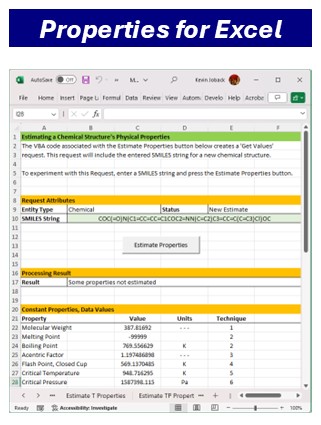
Cranium's Component Edition can interface with third-party software packages such as excel. Excel can call Cranium's functions for data retrieval, property estimation, units conversion, and molecular structure entry. This poster shows an Excel spreadsheet that takes as input a chemical's molecular structure in SMILES notation. The spreadsheet then requests Cranium to estimate eleven physical properties.
Physical Properties for Python (back to booth)
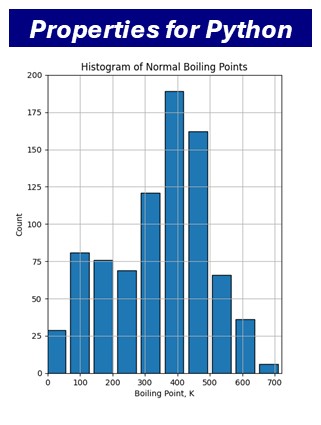
Both Cranium and Synapse can generate physical properties for use in Python programs. The applications generate a databank containing both physical property data and estimates. The databank provides these values in an object-oriented format using the MKS Property Classes. This makes it very easy to manipulate the values using simple Python functions. This poster shows a histogram generated by an Python program that processed a databank containing 837 boiling points retrieve from the MKS Core Knowledge Base. For more information, please visit our Python Documentation webpage.
Physical Properties for MATLAB (back to booth)
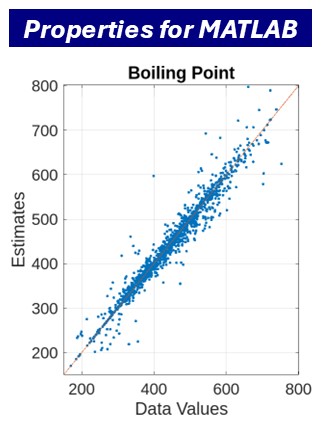
Both Cranium and Synapse can generate physical properties for use in MATLAB programs. The applications generate a databank containing both physical property data and estimates. The databank provides these values in an object-oriented format using the MKS Property Classes. This makes it very easy to manipulate the values using simple MATLAB functions. This poster shows a plot of boiling point estimates versus boiling point data. The boiling point values were exported from the MKS Core Knowledge Base and loaded into a MATLAB session. For more information, please visit our MATLAB Documentation webpage.
Brochures (back to booth)
Whitepapers and Articles (back to booth)
Coming Soon
Molecular Knowledge Systems (back to booth)
Thank you again for visiting our virtual exhibit booth. Please click on the following links to visit our website, for more information on Synapse, our chemical product design software, Cranium, our physical property estimation software, or our consulting services.
If you would like to talk further about Synapse, Cranium, our consulting services, or if you have any questions about chemical product design or physical properties, please send us an email: